
New Starshade Additions to EXOSIMS

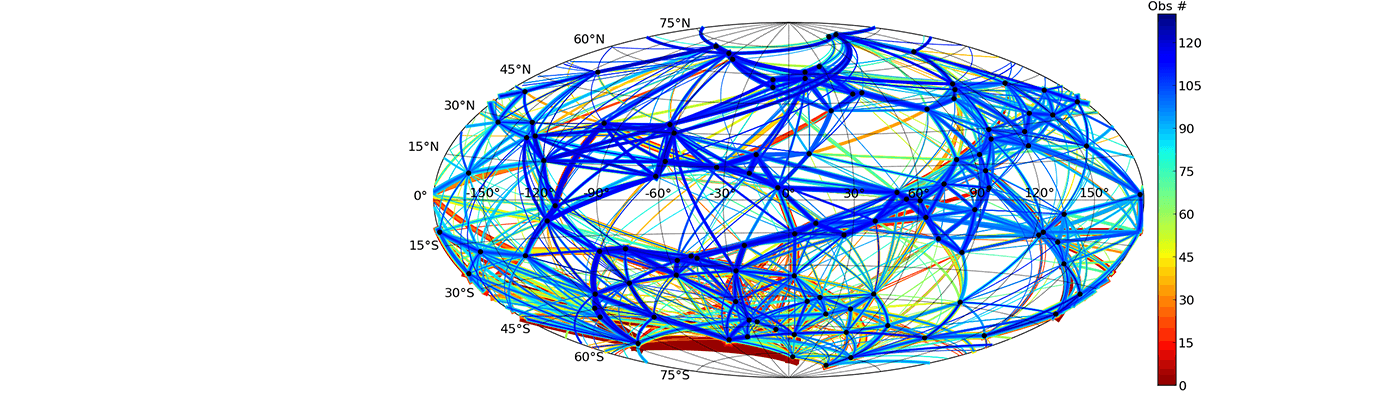
I have been working recently on the integration of a new starshade class into EXOSIMS which can simulate starshade motion with higher fidelity. The humbly named SotoStarshade class integrates the circular restricted three body equations of motion to find the states of the occulter as it dances around a telescope on an L2 halo orbit in a rotating frame. As of now, it can solve boundary value problems to determine slew trajectories: while the telescope slews to a new target the occulter flies over to align with the telescope’s line of sight. This slew time can be varied accordingly to reduce the amount of fuel used in the impulsive maneuvers or can even be minimized given fuel constraints. With this new starshade class, trajectories can be generated throughout the mission.

The video shown above shows the simulation of the starshade motion about L2 as the telescope slews to view new targets. Slew times are set to 20 days for every target and the station-keeping motion is not shown. New methods will be introduced in the near future that can interpolate the fuel costs for quick calculations and vary the slew times to sync with targets coming in and out of the Sun (and other planetary) keepout zones in the sky; a new scheduler will also be added to the SurveySimulation module.
SPIE Optics + Photonics 2017

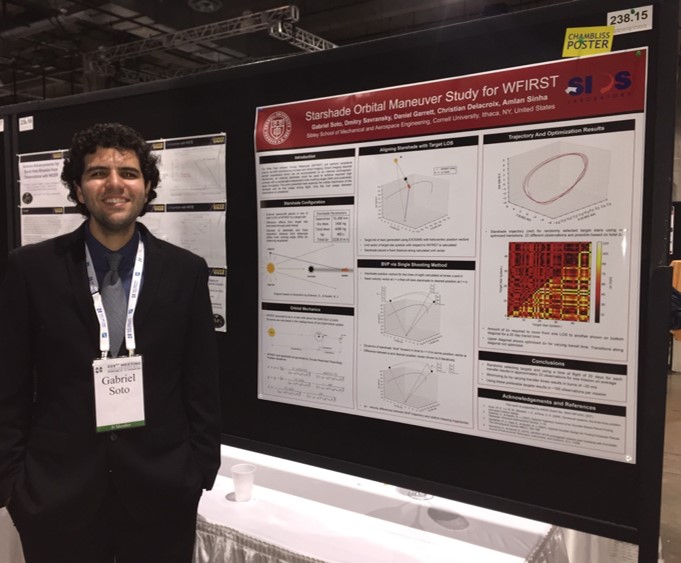
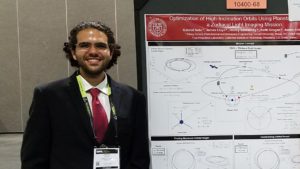
Quite a few of us attended the SPIE Optics + Photonics conference on 6-11 August 2017 in sunny San Diego, CA. Daniel Garrett presented his paper “Detected exoplanet population distributions found analytically.” Dmitry Savransky presented his paper “Multi-mission modeling for space-based exoplanet imagers.”  Jacob Shapiro presented his paper “Planet signal extraction from direct imaging using common spatial pattern filtering.” Gabriel Soto presented his papers “Starshade orbital maneuver study for WFIRST” and “Optimization of high-inclination orbits using planetary flybys for a zodiacal light-imaging mission.”


A 30 Second History of Exoplanet Exploration

I recently updated a video I’ve been showing for the last few years in public talks on exoplanets.  This shows the current population of known exoplanets, in order of discovery and coded by discovery method.

The code to generate this video is available at: https://github.com/dsavransky/miscpy/blob/master/Animaitons/exoplanet_history_anim.py

Data is from the NASA Exoplanet Archive (http://exoplanetarchive.ipac.caltech.edu/).

SGRS at Cornell, January 20th 2017

SIOSLab attended the 2017 Sibley Graduate Research Symposium (SGRS) held in Upson Hall at Cornell University on January 20th, 2017. Joyce Fang presented her talk titled “Misalignment Retrieval of an Off-axis Parabolic Mirror using Kalman Filtering.” Jacob Shapiro presented his talk titled “Improved Signal Detection in Direct Imaging of Exoplanets.” Gabriel Soto presented his talk titled “Starshade Orbital Maneuver Study for WFIRST.”

229th AAS Meeting

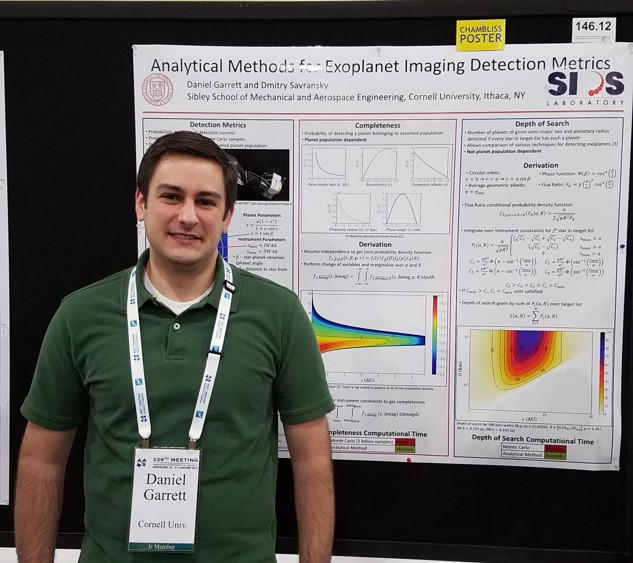
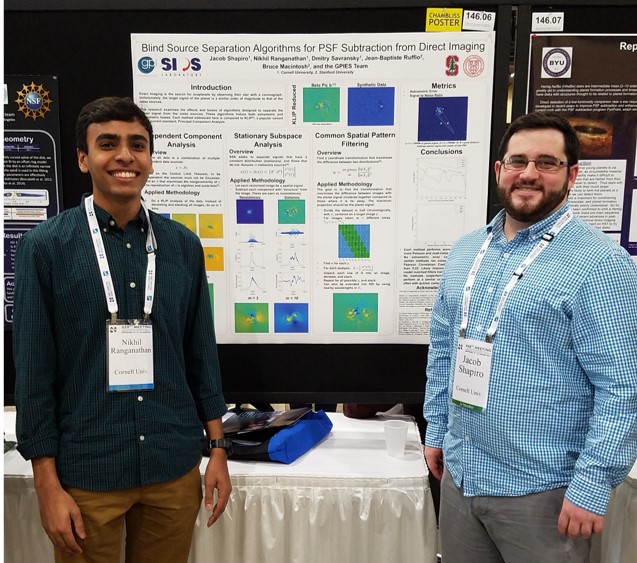
SIOSLab attended the 229th AAS Meeting in Grapevine, Texas earlier this month. Daniel Garrett presented his poster titled “Analytical Methods for Exoplanet Imaging Detection Metrics.” Jacob Shapiro and Nikhil Ranganathan presented their poster titled “Blind Source Separation Algorithms for PSF Subtraction from Direct Imaging.” Gabriel Soto presented his poster titled “Starshade Orbital Maneuver Study for WFIRST.”


NASA Deputy Administrator Visits SIOSlab

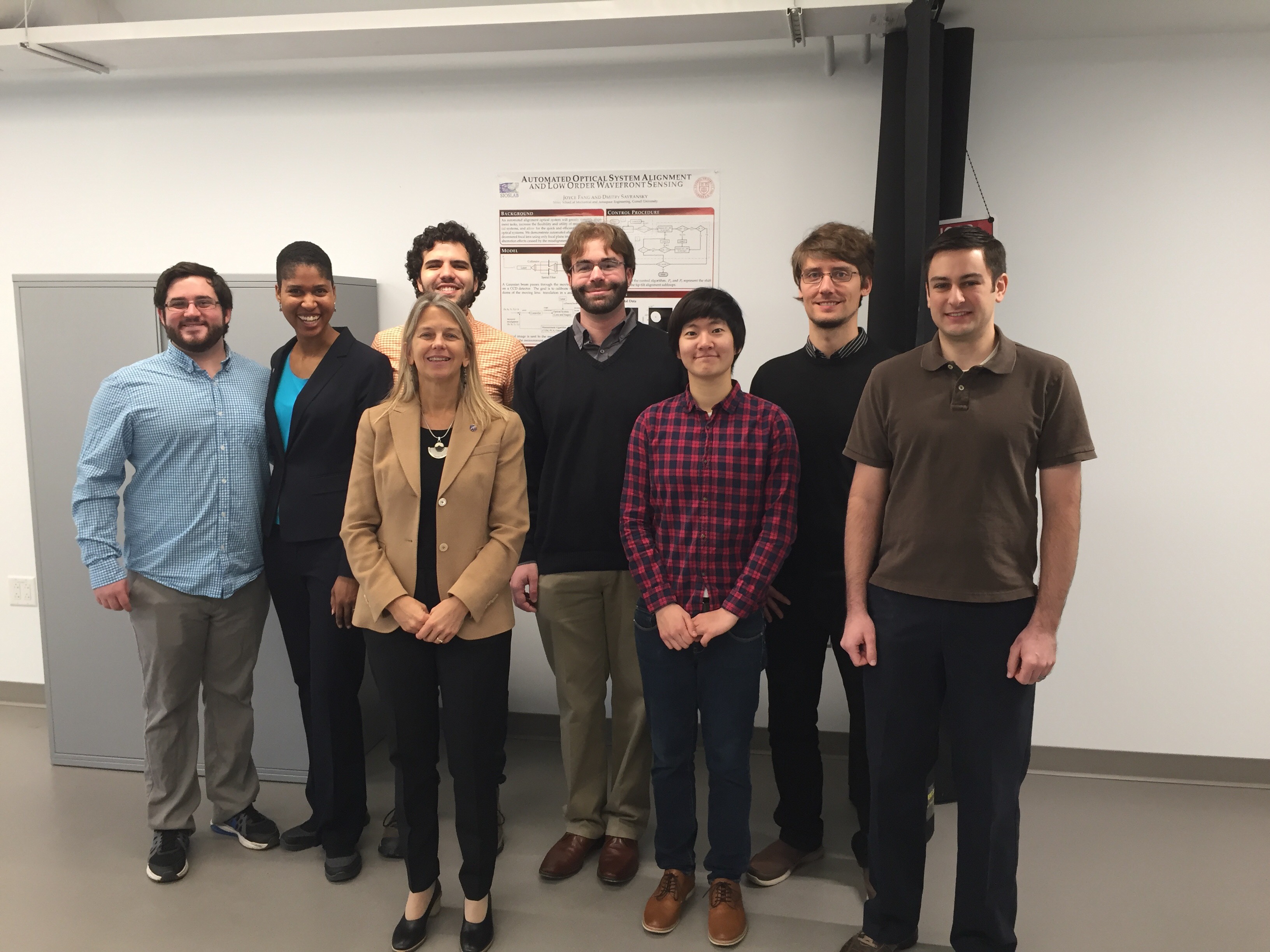
img_1562As part of her recent visit to the Sibley School, NASA deputy administrator Dava Newman stopped by SIOSlab to hear about our work.  We were all very excited to share our research, especially as so much of our support comes from NASA. Many thanks to Dr. Newman, Danielle Wood, Ana Diaz Artiles and everyone involved in making her visit here a great success.

Pictured (left to right):  Jacob Shapiro, Danielle Wood (Special Assistant to the Deputy Administrator), Dava Newman, Gabriel Soto, Dmitry Savransky, Joyce Fang, Christian Delacroix, Daniel Garrett.