
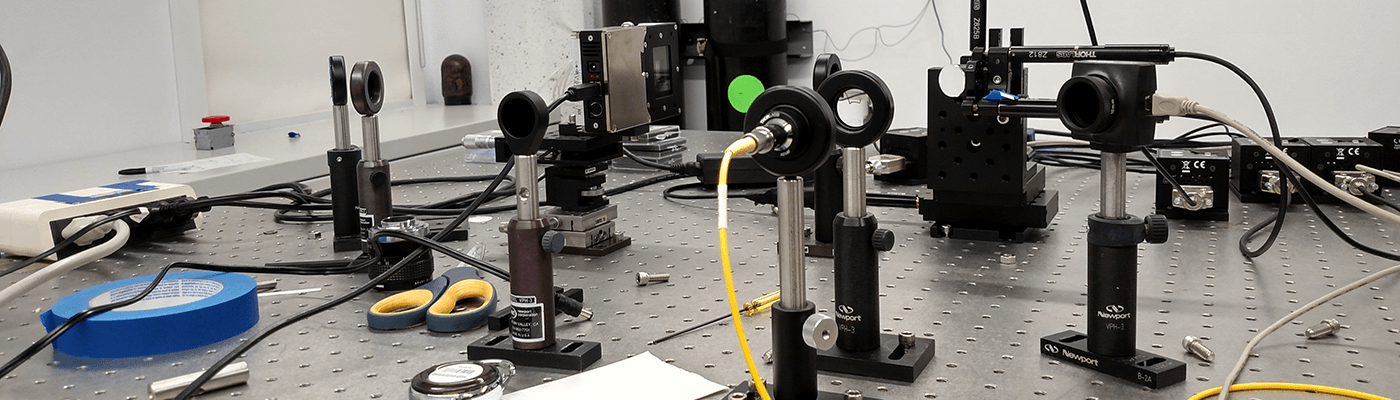

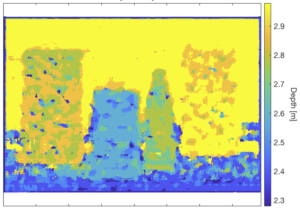
 Michael Wang (SIOSlab MEng 2018) presented at the St. Lawrence Section meeting of the American Society for Engineering Education (ASEE) conference and was awarded the best graduate poster award for his work on Coded Aperture Ranging.
SIOSlab Selected for 2018 NIAC
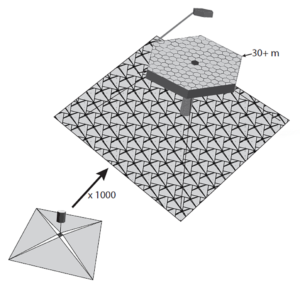
Our proposal: Modular Active Self-Assembling Space Telescope Swarms has been selected for the 2018 NIAC Phase I. The NASA Innovative Advanced Concepts Program seeks to develop radical and revolutionary new concepts that could potentially lead to wholly new classes of NASA missions and unprecedented technological and scientific breakthroughs.
Our study will seek to establish the feasibility of constructing giant space telescopes, far beyond the scale that would be possible with conventional construction techniques, out of standardized, mass-produced modules. These modules would be launched individually or in small groups, preferably as payloads of opportunity on other launches, and would navigate to the vicinity of the Sun-Earth L2 point using solar sails for propulsion. There, the swarm of modules would assemble autonomously, taking advantage of the novel dynamical environment, with the top sides of the modules becoming segments of the telescope mirror, while the solar sails become components of a giant, planar sun-shield. The mirror segments would all be active optics to allow for the setting and control of the required overall mirror shape. We are greatly honored by our selection, and excited to get started on this project.
This project has also been covered by the Cornell Chronicle and Motherboard.
JOSA A Paper Published
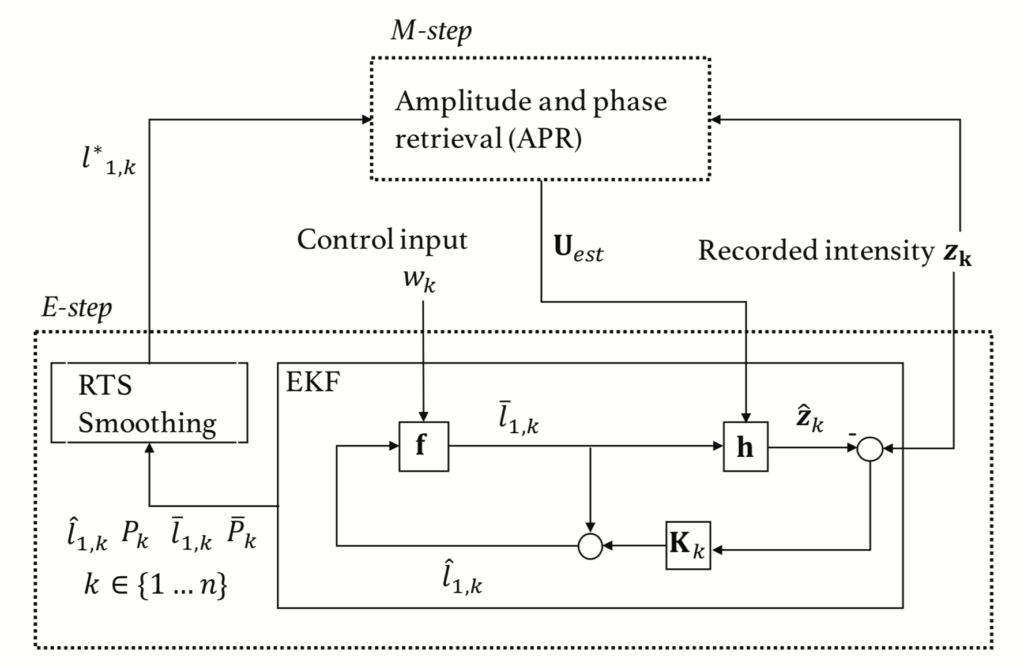
Our new paper titled “Amplitude and phase retrieval with simultaneous diversity estimation using expectation maximization” has been published in OSA JOSA A. The paper can be accessed through DOI.
231st AAS Meeting
A couple of us from SIOSLab attended the 231st AAS Meeting which took place in Washington, D.C. earlier this month. Daniel Garrett presented his poster titled “Building Better Planet Populations with EXOSIMS.” Dean Keithly presented his poster titled “Exoplanet Target Selection and Scheduling with Greedy Optimization.” Gabriel Soto presented his poster titled “Starshade Observation Scheduling for WFIRST.”
Direct Imaging Post-Processing Research Update
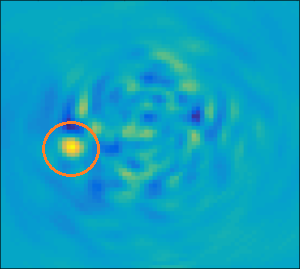
We have been working on using Common Spatial Pattern filtering in a novel method to detect exoplanets from direct imaging. Using just time-series data, CSP filtering can identify a known exoplanet, Beta Pictorus b (in image below). Right now, work is being done to implement spectral characteristics from the observations into the data reduction process as well. Similarly, we are preparing to run large-scale statistical analysis across hundreds of observations. This will serve to compare to the current method, Principal Component Analysis. Hopefully we can identify situations in which CSP outperforms PCA in planetary detection.
New Starshade Additions to EXOSIMS
I have been working recently on the integration of a new starshade class into EXOSIMS which can simulate starshade motion with higher fidelity. The humbly named SotoStarshade class integrates the circular restricted three body equations of motion to find the states of the occulter as it dances around a telescope on an L2 halo orbit in a rotating frame. As of now, it can solve boundary value problems to determine slew trajectories: while the telescope slews to a new target the occulter flies over to align with the telescope’s line of sight. This slew time can be varied accordingly to reduce the amount of fuel used in the impulsive maneuvers or can even be minimized given fuel constraints. With this new starshade class, trajectories can be generated throughout the mission.
The video shown above shows the simulation of the starshade motion about L2 as the telescope slews to view new targets. Slew times are set to 20 days for every target and the station-keeping motion is not shown. New methods will be introduced in the near future that can interpolate the fuel costs for quick calculations and vary the slew times to sync with targets coming in and out of the Sun (and other planetary) keepout zones in the sky; a new scheduler will also be added to the SurveySimulation module.
SPIE Optics + Photonics 2017
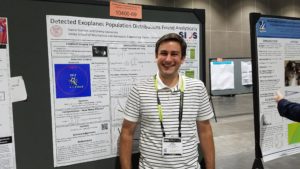
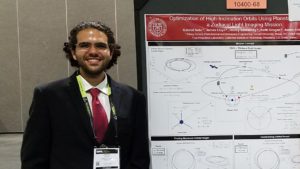
Quite a few of us attended the SPIE Optics + Photonics conference on 6-11 August 2017 in sunny San Diego, CA. Daniel Garrett presented his paper “Detected exoplanet population distributions found analytically.” Dmitry Savransky presented his paper “Multi-mission modeling for space-based exoplanet imagers.” Jacob Shapiro presented his paper “Planet signal extraction from direct imaging using common spatial pattern filtering.” Gabriel Soto presented his papers “Starshade orbital maneuver study for WFIRST” and “Optimization of high-inclination orbits using planetary flybys for a zodiacal light-imaging mission.”
AJ Paper Published
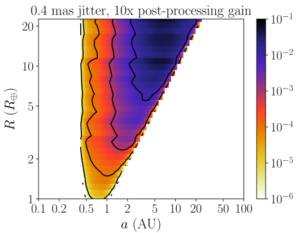
Our new paper, “A Simple Depth-of-Search Metric for Exoplanet Imaging Surveys,” has been published in The Astronomical Journal. Access the paper here.
Congratulations to Daniel Garrett on Passing his A Exam!
Daniel Garrett successfully passed his A exam on May 24th, marking his entrance into the dissertation phase of his degree program.
A 30 Second History of Exoplanet Exploration
I recently updated a video I’ve been showing for the last few years in public talks on exoplanets. This shows the current population of known exoplanets, in order of discovery and coded by discovery method.
The code to generate this video is available at: https://github.com/dsavransky/miscpy/blob/master/Animaitons/exoplanet_history_anim.py
Data is from the NASA Exoplanet Archive (http://exoplanetarchive.ipac.caltech.edu/).